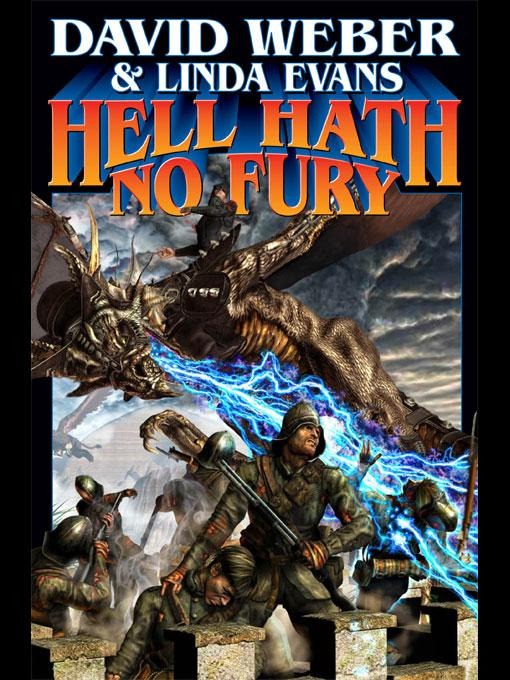
I recently had the opportunity to pick up a pair of David Weber books I had not yet read. (Well, “pick up” in a figurative sense, as I read them as free e-books from the Mission of Honor CD on The Fifth Imperium Baen CD repository.) I found them to be quite exciting page turners, with only a few minor drawbacks. The books in question make up the “Multiverse” series: Hell’s Gate and Hell Hath No Fury. As with all Baen titles, they are available in multiple, DRM-free formats.
The books are actually co-written between Weber and Linda Evans, who seems to be Baen’s designated co-author—apart from two singleton books, neither of which apparently sold well enough to merit a sequel (most frustrating in the case of one of them, The Far Edge of Darkness, which ended on a literal cliffhanger!), she has only co-written books with the late Robert Asprin, John Ringo, and now David Weber.
The Setting
The “Multiverse” books tell the story of the first encounter between two different human civilizations, both of which have been exploring chains of alternate universes connected via portals that have been forming from one earth to another. Most of these universes are bereft of any human presence, which makes them ideal for settling and exploiting natural resources (which are always in the same place from world to world, even though the portals open into different areas of each world—there will always be oil fields under the local equivalents of Texas or the Middle East, for example, but not every world has a portal open near there).
One civilization is the Arcanans, a world of magic users who have magical Gifts that, over the centuries, they have learned to use in a positively inverse Clarkian sense—their sufficiently-advanced magic is the equivalent of our 20th century technology, including crystal computers and PDAs that run “spellware”, and dragons (created, like other creatures, through magical genetic engineering) that are equivalent to fighter and transport planes. They also have magical heavy weapons that throw fireballs or lightning bolts. Only those with a Gift for magic can use this magitech, though, and their non-magical technology is several centuries behind—their personal non-magical weapons are swords and arbalests, and they ride around on (magically genetically-enhanced) horses.
The other civilization is the Sharonans, a world of technologists with psionic Talents. As these talents are more limited than Arcanan Gifts, they have developed technology to compensate, and are technologically equivalent to the beginning of the 20th century. They have rifles, machine guns, cannons, and steam ships and trains—but the internal combustion engine has only just been invented, and they have no aircraft yet. However, their deadliest weapons can be used by anyone, whereas only the Gifted can use Arcana’s magical ones.
But neither of these civilizations is monolithic. They both have different countries, some of which get along better than others. And they have both been sending teams of explorers through portals into alternate worlds for decades. Neither civilization had yet encountered other human portal explorers, but both had plans and protocols in place for a peaceful first contact.
However, when the fateful first encounter occurs between two armed scouts who end up killing each other without leaving any clues as to who shot first, the contact gets off on the wrong foot and only goes from bad to worse.
The Story
The books are an evocation of Murphy’s Law in action, a chain-reaction clusterf—k that grows bigger and bigger as it picks up momentum like a snowball going downhill fast. Although most of the people involved on both sides are decent men who only want to do the right thing, there are enough bad apples—a coward here, a sociopath there, a scheming military officer who is actually a member of a secret nationalist conspiracy here, a pair of diplomats who are also enmeshed in that conspiracy there—that the eventual outcome is never really in any doubt.
In fact, there are sufficient conspiracies or lone bad actors on both sides, each of whom sees an opportunity for advancing his own agenda in a war, that both sides soon find themselves locked into an inevitable collision course, like two trains approaching on the same track. But even good men can also succumb to fear and hatred of the Other, especially after cohorts or beloved public figures on both sides are killed or supposedly killed by the other side. The situation gets worse and worse, until by the end of the second book it is hard to see how it could possibly get better.
Pros
The good thing about these books is that they are exciting to read. Weber and Evans do a great job of creating two entirely believable sets of civilizations, neither of of which is identical to our own but both of which have enough similarities to it that we can relate. They have different strengths and weaknesses, but are generally well-matched. Because the books have an ensemble cast, there are a number of different individuals within them that get screen time and are fleshed out into believable sympathetic (or antagonistic) characters—we care what happens to them, whether we want it to be something nice or something nasty.
The technology of the different universes is well-developed, too. The authors set down some basic ground rules, and are very good at sussing out the implications of particular technological or magical developments based on those rules. Given the bases from which they start, the technological developments make sense.
The world-building on the sociological side is also good, with enmities between people of various different countries explained in ways that make sense. There’s a lot of information here, and if it often comes in the form of the “data dumps” for which Weber is renowned, at least that’s less tedious than if they tried to shoehorn it artificially into dialogue.
Cons
But there were a few annoying things, too. None of them make the books unworthy of reading—not even all of them put together. But it would be nice to see some of them addressed, perhaps in future books.
For one thing, the geography of the world could use some explication. Through hints dropped in the book, it’s made plain that the geography of both Arcana and Sharona match that of our own in the “real” world. A number of geological features are mentioned, such as the Rock of Gibraltar, and enough clues are given that a reader willing to put thought into it could work out exactly what each country corresponds to in the “real” world. (They even hint that it takes place in what would have been “our” year 1920, by reference to the explosion of Krakatoa.)
But there’s only so much a given reader can keep in his head, and I found it impossible to work out from some of those clues exactly where each region is. It would have really been helpful to me to have some kind of a world map—or, rather, two world maps—with country and city names marked. (With inserts as necessary for smaller countries.) It would have helped me get a sense for where each of the nations was, how they related to each other, and what the equivalents were in the “real” world. But neither of the books had that.
I had trouble with something else, too, though I think it may have been just me. None of the characters’ names in these books has an analogue to names in the real world. They are all completely foreign, and as such, I had a hard time keeping them all straight in my head. I noticed something similar when I was reading the 1632 series by Eric Flint recently. The foreign names just sort of…blend together, and I have to just read along and try to work out what’s happening and who it’s happening to as I go along. (This frankly worries me—I’ve never had this kind of problem before. Am I getting older? Is my brain starting to turn to mush? Ugh.)
The Long Wait
And one more problem, though not necessarily one endemic to the books themselves, has to do with the current lack of a sequel. It has been two and a half years since these books were originally published (in April and June 2008, leading me to suspect they may originally have been meant to be one book, but it got so long they had to break it into two), but no sequel is on the horizon yet.
The thing is, David Weber is an amazingly prolific writer. The bibliography on his website lists an astonishing total of 56 books (novels or anthologies) since 1990—an average of about 2 1/2 books per year for twenty years (though some of those books are omnibus editions of others). These include over half a dozen different series, and he rotates which series he writes for next. This means that fans of one particular series will usually have a several year wait before the next book in that series.
This has driven some fans (usually fans of a specific series) to distraction, and some have occasionally responded with the same kind of entitlement-laden posts as those fans who complain about George R.R. Martin’s diet. But as a writer myself, I know it can be hard to resist the lure of a story that particularly wants to be told.
And the Multiverse series is no exception to this. The David Weber FAQ noted in 2009:
In the Hell’s Gate series, there are two more books under contract, but the project is in hiatus while David tries to catch up with his writing schedule. He has told people at Cons that he had no business starting "still another series", but he wanted to tell the story so badly that he bit off more than he could chew. This was actually one of the original series that he pitched to Jim Baen all those years ago, and he’s been itching to get it told. It’s a good story!
I haven’t been able to find any more recent news as to when we can expect another book in the series (indeed, the only two upcoming Weber books I can find listed for the near future are in the Safehold and Honor Harrington series). This is rather aggravating as the series ended, if not on a cliffhanger, at least on an irritatingly unresolved note.
Unlike the entitled fans, I realize I don’t really have any business complaining about what Weber chooses to write—especially since so many fans of his other series are in exactly the same boat. (Including me; I wish he’d do more Bahzell books, too!) Still, I’m glad I at least waited 2 1/2 years to read the books, as now I’ll spend 2 1/2 fewer years anxiously waiting to find out what happened next to those characters Weber and Evans made me care so much about.
If you don’t mind waiting an uncertain length of time to find out what happened next, these books are well worth reading. But if that sort of thing bothers you, you should hold off for a while. After all, they should still be free by whatever time the next one comes out.
View the original article here